Marmalade


Marmalade.
I was never all that happy with the previous batch of marmalade I made in 2014. I thought it had been boiled too much, as it was quite a dark colour, and recently, I noticed that what I thought was the last jar was getting quite low.* There are only a couple of weeks of the year when the right oranges for marmalade making are in the shops, and last week I found some in Tesco. I grabbed the last Kilo.


In case you don’t know, proper marmalade is made with Seville oranges, named after the part of Spain where they are grown. These oranges are a bitter variety, full of pips. You wouldn’t want to eat them, or drink the juice. If you use ordinary oranges, you will end up with some sort of orange jam, that may well be very pleasant, but it won’t be marmalade.


If you are not near enough to Spain to have them in the shops, and want to make marmalade, look for something too bitter to enjoy, with unbelievable numbers of pips. The pips are more important than you might think, as they are full of the pectin that makes the marmalade set. 

As well as a Kilo of oranges, you will need two Kilos of granulated sugar, and two lemons. I don’t know why Tesco is only stocking foreign sugar, but local shops like Spar and the Co-op do have British sugar, made from beet. [It may have something to do with a certain government minister who used to be high up in that foreign sugar company.]


Ingredients.
1 Kg Seville oranges
2 lemons
2 Kg granulated sugar
500 ml water

These are Seville oranges; look at those pips!


The method. 
You will need a pressure cooker for this recipe. There are other recipes involving boiling things for hours, and I’m sure they work pretty much as well as this one does, but we have a pressure cooker, and it saves quite a lot of time. Cut the oranges in half, squeeze them with one of those glass juice squeezing things, which I completely forgot to take a picture of. Put the juice, and the peels in the pressure cooker. Add the juice of two lemons, but not their peels. The lemon pips can go in with the orange pips.

I used a plastic strainer to stop the pips going in. There tend to be pips still hiding in the peels, but that can be sorted out at a later stage. The pips get wrapped in a nice open weave cloth, such as cheese-cloth, muslin, or whatever you have handy that seems reasonable to use in cooking. Now add 500 ml of water. The picture on the left is the contents of the pressure cooker before boiling.


And here’s a picture of the contents of the pressure cooker after ten minutes of boiling at full pressure, followed by allowing them to cool naturally to room temperature. Notice that the pith of the oranges is cooked, and very much softer than before.


Transfer the juices to your preserving pan. It’s nice if you have a big copper plated pan for this, but we use a big old Teflon saucepan. Hooked onto the side, is our old sugar thermometer.

Now you need to squeeze the pips into the pan, until they… no, just squeeze them until you don’t think you will get any more out of them. Squeezing pips until they squeak turns out to be really difficult. Only politicians can do it. 
Throw the bag of pips away once you have got as much as you can from it. The pips supply pectin, which is what makes the marmalade set nicely.
Now, chop up the peels to your preferred size chunks. Some people like very fine pieces of peel, while I quite like big chunks. I’ve cut these ones to a medium size, as my wife prefers them small. Notice that this is when you remove the pips that have been cunningly hiding in the peels. 

Put the chopped up peels in the pan with the juice, and bring them to the boil.

Tip in the two Kilograms of sugar, and stir until it is properly dissolved. Keep heating, and keep stirring. You need to raise the temperature to 105°C.
Warning! Hot, concentrated sugar solution holds much more heat than mere boiling water, and if you splash this on yourself it will burn you badly.

That old sugar thermometer is no longer doing its job properly! It was showing something a bit below 105°C, but I thought the marmalade was looking ready, so I checked it with a cheap electronic thermometer, and as you can see, the marmalade was done! If I had heated it until the old thermometer said it was done, I would have had another batch of over-boiled marmalade.


There are all sorts of ways to test whether your marmalade is going to set, including cold saucers in the fridge, with a splash of marmalade on, but I don’t think this recipe can avoid setting, if you follow it properly, and make sure you get it to the magic 105°C.

All that remains to do is put it in clean jars. Dishwashers are the best way to clean jam jars. If you don’t have one, you’ll have to boil them up in some suitable manner. Below, you see my results. It’s very much better looking, and tasting, than the previous batch.


* I found another jar of the old, dark stuff. I threw the contents away.

Cretan Loukanika – Part 1

We went on holiday for a fortnight in Crete, this year. As ever, I loved the food, and brought back a recipe book. It’s not without its problems. I keep meaning to finish a scathing article on the many things recipe books get wrong, but don’t hold your breath for me to get that done!

Loukanika are also called village sausages, and the authentic ones in tavernas vary a lot from place to place. I tried to make some before, using a recipe that involved lots of orange zest and paprika, but wasn’t really convinced they were anything like the Greek ones we had eaten.


Here’s a good example of a problematic recipe! For a start, there’s no clue as to how much pepper, cumin, and salt to use. And the method completely forgets to put the pork in… But we can cope with minor problems like that!

I had 1400g of pork shoulder, and ran it through the mincer. They may have meant the sort of malt vinegar that gets put on chips, for all I know, but I made a mixture of red wine vinegar, sherry vinegar, and a splash of balsamic. I used 700g of it, and I can tell you now, that turns out to be about twice as much as is actually necessary. As the vinegar seemed to be intended to cure the meat, I only used 30g of salt. Using the cooking skill known as guesswork, I ground up 20g of black pepper corns, and added 50g of dried cumin. It smelled about right, I felt.
Into the fridge it went, for six days, during which I obtained about forty yards of pig casings, from a UK company called Breck Casings. If you are not in the UK, you should be able to find a supplier easily enough with Google.

When it came to time to stuff the casings, it was obvious the mixture was far too wet, and I used a sieve to attempt to dry it out a bit. Even then, it was a struggle, with vinegar dripping from various parts of the mincer as I worked.
Still, the resulting fourteen sausages looked reasonable. They are tied with butchers’ string like that so that they would hang easily over the wire at the top of my large smoking dustbin. You might not be able to see it, but most of the sausages are linked together by unfilled bits of casing. 
We had no cedar wood sawdust, and there was no obvious online source that wasn’t asking for absurd amounts of money, so I used oak. You can see I added some herbs, as the recipe suggests, thyme, sage and some very nice Lesbian oregano. The smoker, in case you are wondering, is called a Pro-Q, and it does a very good job.
Here are the sausages, hung up in the smoker (galvanised dustbin) yesterday evening, with the smoke just starting. A few hours later, vinegar dripped on the sawdust and put it out.

I’ve reloaded the Pro-Q and lit it up again, with the bin tilted so that any further drips miss the sawdust. Once they are smoked, I will be able to report on whether they are more authentic than the previous batch.

Fish, two ways…

This is fish the first way, a salmon fillet with no bones in it, served with some new potatoes, cauliflower, home grown broccoli, and parsley sauce from a packet. It was very pleasant with a white wine to help it on its way. My wife liked it, and there were no bones in the fish to annoy her.

However…


These little beauties are sprats, and they are so cheap that I allow myself a big handful as a treat, when my wife is away. Treat? These cost less than a pound. 

I was asked to make these postings more instructional. So, off with their heads, use the pointy end of the knife to gut them, and shake them in a bowl with a little seasoned flour, until they are covered thinly with it. Heat a pan with some olive oil in it, and put the fish in. The lass in the shop, that sold them to me said she had stirred hers, and they broke up. No surprise, poor little things. After a couple of minutes, turn them over and give the other side a couple of minutes.

This is the result. I got a bit excited, and ate one before I took this picture. The flesh comes off the bones very easily, but it’s a good idea to have bread and butter handy, to eat with any bones you might happen to put in your mouth. They won’t last five minutes in stomach acid, so it doesn’t matter if you eat some.
Then again, if you don’t, you will have something like this left. Obviously, they go in your compost bin, and will make things grow well in your garden….

Bon appetite, as we say here in Wales!


Smoke me a kipper, I’ll be back for breakfast!

Step 1. You will need to catch your herrings; I caught mine in Tesco, of course. Well, the sea was a little stormy this week, and I don’t have a boat.

Step 2. Off with their heads, which will get used to make fish stock when I next need some. In the meantime, they live in the big freezer, along with the mackerel heads from an earlier episode of this journal.
I‘ve given up numbering the steps, as it was far too much faffing about. As I was gutting the herrings, I was pleased to find they were nicely full of roes, which I saved in the freezer, to be used in somthing tasty when I think what it will be. Perhaps I will smoke them lightly and put them in a taramasalata. That’s the only word with six As in it that I know, by the way.
Cutting along one side of the spine, almost all the way to the top of the fish, enabled me to open them out into the normal kipper shape. I’m going to have to remove the bones from any I try to serve to Mrs Walrus, of course, but these are not shop-style filleted kippers. I was going to leave the tails on, but it made them harder to fit on the racks. In big smoke houses, they use the tails to hang the herrings up for kippering, I believe. Having had fish fall down onto the smoking wood in a previous adventure, I did these beauties on racks. The racks are suspended  on hooks made from 2mm galvanized wire, quickly bent with a pair of pliers. At some point, I will make something that doesn’t have to hang over the edge of the smoking bin, as that lets quite a lot of smoke out.

I‘m not sure if you can see it very well in this shot, but smoke is escaping. This time, the wood was a blend of cherry, beech, and alder. I thought maybe the oak I used last time might be a bit too strong. Twenty minutes seemed like a suitable length of time to smoke for, and indeed, the wood ran out of smoke at about that point anyway.
Here we have kippers! They don’t look raw, and are waiting in the fridge for a suitable breakfast at which to serve them. I’ve been trying to remember how we used to heat them up for serving when I was young. I’m fairly sure a frying pan was involved, but then again, the microwave does a good job of warming smoked mackerel, so I might just use that.

The duck is not getting smoked…

When I was planning our Sunday dinner, I thought it might be interesting to smoke the duck breasts for added flavour. But, as I hadn’t done that before, I did an experiment on Saturday, with a chicken breast, to see whether I liked it.

This miniature galvanised dustbin is what I use for hot smoking. I bought it on eBay for a very reasonable price. Putting the smoking wood in the bottom and heating it on the lowest gas setting of the smallest burner produces plenty of smoke.
Here’s the set-up with a test chicken breast in it. The shelf is a cooling rack, again from eBay, and the hooks are made from 2mm galvanised garden wire. I put the bit of foil in to stop drips falling onto the wood, as burnt chicken juice is not a particularly pleasant flavour! The digital thermometer probe’s end is in the thickest part of the chicken breast.
Lid on, and light up! I kept an eye on the temperature, and turned the extractor fan right up to avoid setting off the smoke alarm. After about ten minutes, the volume of smoke escaping from the top of the dusbin was very much reduced, and at twelve minutes, the inside of the chicken had reached 55°C, so I turned the gas off. That’s supposed to be the right temperature for a nice pink duck breast, according to the internet. If you happen to be in America, it’s also, the internet says, dangerously undercooked. Since well-done duck is pretty much not worth eating, I ignore such warnings.
As you can see, the chicken is cooked, but still very pleasantly moist. The smoky coating on it was very strong tasting, and I think either a different smoke wood, or a lot less of it would have been better.

I was very pleased with the result, though. We decided not to use the smoker for our Sunday dinner, after all.
Here it is, with boiled new potatoes, steamed courgette and pak choi. The sauce has white wine, orange juice, and orange zest in it. The duck was delicious, as usual, and I really don’t think it needs any extra flavour.

[Gressingham Duck, feel free to advertise on this page!]

Toulouse sausages…


These sausages are a step on the path to a mighty cassoulet that I intend to make soon. The inspiration for the cassoulet comes from Tim Hayward’s book, “The DIY Cook”. The book can actually be bought new for less than half the price Amazon are asking.

Along the way to the cassoulet, I have already made and stored confit duck legs, and petit salé, which is a sort of French cured pork, a bit like bacon.


The Toulouse sausage recipe I used, however, is not the one in this book, as I liked the look of the recipe I found online, on a blog called “Adventures with the Pig”. I used rather more meat than he does, 2 kg in fact, and left out the breadcrumbs, which I feel have no place in a sausage. You don’t have to take my word for that, and are at perfect liberty to add things to your sausages if you want to. Of course, they’ll be inferior, but the freedom!


I used one kilo of pork shoulder (pork butt, if you are on the left of the Atlantic Ocean), and one kilo of pork belly. They were cubed and frozen, before being allowed to nearly defrost. Doing that stops the loss of delicious meat juice during the mincing. This one requires the coarse setting of your mincer, as it’s supposed to be a nice rustic sausage.


Here are the casings, in this case, they are hog casings. They need to be soaked for a couple of hours before use. There’s no getting away from it, these things are unpleasant to handle, but either you want real sausages, or you don’t.

There are people who insist on using a hand powered mincer, and I imagine they have one arm very much bigger than the other. Here’s what I use, on our trusty Kenwood Chef. I’ve had that plastic bowl since 1979, if you were wondering. (Update: I recycled the plastic bowl. It was getting fairly thin in places…)

The other ingredients are thyme, black pepper, nutmeg, garlic, red wine (200 ml) and about four teaspoons of salt. Ordinary cooking salt is fine. You don’t need Nigella’s beloved Maldon salt, or kosher salt, whatever that is.

Here we go! Add the herbs, spices, salt, and red wine to the minced meat, put on your CSI glove, and get stuck in. I always hold my gloved hand under a tap, to attempt to remove the talc, or whatever it is, from the glove before I get started on this.

Mix for a good long time, until everything seems to be properly blended. This can easily take ten minutes, by which time you will have a worryingly cold hand.

Once you think you have mixed it enough, take a little sample, and fry it, so you can check you are happy with the flavourings. Adding more, if something seems to be lacking, is easy, but I have no idea what to do if I think I have put too much garlic. This has never happened, but I am a great fan of garlic…


Caption competition.

The casings need to be slid onto the sausage stuffing attachment. It’s easier if you keep them as wet as you can. I’m going to refrain from all the remarks almost every other web site makes about this process at this point.

Load up the machine with mince, and away you go…

Left hand guides the sausage, and slows down the casing, so it fills properly, while your right hand pushes the meat down into the machine. If you are left handed, you will need to stand on your head, or turn the machine round.

You can twist them into links as you go, or when you have finished. I’ve done them both ways, and the results seem much the same.


In a surprisingly short time, you will have lovely sausages, in large numbers. I tend to divide them into groups big enough for a meal and cling film them before freezing them.


Smoked Mackerel, Food of the Gods.

I’ve been meaning to try smoking food for a long time, and finally got round to it. The inspiration for this little project came from Tim Hayward’s book, “Food DIY”, as so many of these fun things I do have.


I bought these four nice mackerel from Mr Tesco for the princely sum of £6.16 for 1.76Kg.

I didn’t get the lass on the counter to gut them, or fillet them, because I feel good about being able to do grown-up stuff like that myself.

I removed the guts for disposal, and then cut off the heads, and filleted them. I would normally not waste the tasty heads and the bones, along with the flesh remaining on them, but instead of making fish stock, or even a Singapore fish head curry, I wanted to concentrate on learning the smoking procedures.

Here are the fillets. They are rather pretty this way up, and you don’t get to see some of my rougher knife work this way. I salted them for about half an hour, but forgot to take any pictures of that.

I’ve been accumulating the things I would need for this job for quite a while now, including three bags of wood for smoking. I decided to go for a nice, robust oak smoking this time. The bags of wood came from somebody on eBay, I think.

These days, eBay is one of the first places I look when I want to buy something for these games.

It’s where I got the rather fine bin in the next picture, which is made out of steel, treated by galvanising it. Because of that, it has no paint on it, an important point when choosing something to put on top of the gas hob. It would probably work fine on an electric hob, as long as it was in contact with the heat.

As for those ceramic induction hobs they fit in “designer” homes, I have no idea whether this would work, or the dustbin would levitate and explode. 

I like to cook with gas because I can control it quickly. This matters when you are in the habit of cooking experimentally. Or just mentally…

Flinging some wood in the bin, I set to work to hang the mackerel fillets up, in a similar way to the illustration in “Food DIY”. Instead of the skewer he used, which would have needed holes in the bin, I made a cunningly shaped hanging wire from a metal clothes hanger. You know, the sort that used to be on inner city Ford Escorts as radio aerials, after yobs had snapped the proper ones off.

By this point, things were obviously going far too well.

The fillets, hanging on the wire, looked lovely, and were all ready for some hot, smoky action.

I considered turning the kitchen smoke alarm off, in case the dustbin lid let out too much smoke, but decided instead to turn the cooker hood up to level three, the one that makes a noise like a jumbo jet. I took the metal grills off the bottom of the extractor, in an attempt to get maximum airflow.

I shouldn’t have done that, as I saw they needed cleaning, a job I did when I finished the real fun stuff.
It was time. I lit the gas, and watched anxiously. Quite soon, smoke began to trickle out from under the lid, and it smelled rather amazing. I was rather glad the smoke detector kept quiet, until I thought that I would want to test it later because of that.

I gave it about fifteen minutes of heat, and stopped. There was a fair bit of smoky condensation around the edge of the lid, and it turned out to be more than there would have been if the fish had behaved themselves, and stayed on the wire.

Three of them had broken, and fallen down into the bottom of the bin. I don’t know if salting them for longer would have toughened them up enough to stay on the wire. I’ve decided to get some wire racks to go in the bin, so this will not happen again.


As you can see, most of the wood has given up its smoke, without bursting into flames, and the fish is cooked. It looked and smelled fine, and I retrieved the fallen bits as well.

The weight of the smoked fish produced, apart from the delicious bits that accidentally fell in my mouth, was 768g. Tesco sells smoked mackerel for £1 for a hundred grams, so not only have I produced something wonderful, but i have made a small saving in money terms!
Here are the bits I didn’t taste. I’ve frozen half, and kept the rest in the fridge. Breakfast will be nice…


Paella for two

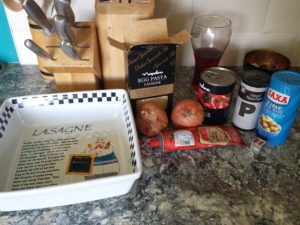
No, I’m not going to give you a recipe. There are thousands of them on the web, and most of the ones that don’t tell you to put chorizo in will be quite acceptable. Here are the ingredients I used.


The onion gets cooked in olive oil until it’s soft first, then the chicken, garlic, peeled deseeded tomatoes, and paprika go in.


Once they seem to be done enough, add the rice, as above, and stock. This is chicken stock from a stock cube (I know, I should be using home made stock, but I’ve run out of it) with some saffron added. Unlike a risotto, where you add the stock a bit at a time, it all goes in at once for a paella. Try not to stir it any more than you need to to stop it sticking to the pan.

I really ought to have a lid that fits this pan.

The finished dish, garnished with fresh parsley. I had to wash the parsley very thoroughly, as the rain had enticed numerous small slugs onto it, that I had no interest in eating.


Barbecue time!

I finished building our barbecue a little sooner than I thought I would, and we had our first barbecue at our new house on Saturday.


First, I defrosted some ribs.


 And cut them up.

Next step is to put them into the newly made (because we have not barbecued for almost two years) rib marinade. It’s based on a sachet of Chinese style red-cooked pork spices, with various appropriate additions. The ribs are boiled in the marinade for twenty minutes. The marinade is now in the freezer, waiting for the next batch of ribs. It improves each time it is used….


The barbecue will probably never be this clean again. In due course, which means when we have enough money, there will be some nice slate paving around the barbecue, but at the moment I’m relying on temporary duck-boards to stop me sinking into the mud.

I have money to burn, you know. I use this joss money from my friends at Wai Yee Hong to light the barbecue. It’s as close as I get to spirituality.

The fire took an age to light, probably something to do with the charcoal being damp, or something like that. Can you forget how to light a barbecue? Aargh!

Anyway, eventually, we had fire, and there was much rejoicing. No, the barbecue wasn’t falling over. It’s probably an artistic choice by the photographer.

Here we see the dual function feature. Ribs cooking, and hand warming at the same time.

We also had lemon and herb chicken on sticks, but I seem to have forgotten to photograph them in all the excitement.

More fire time than food to cook! Much better than the other way round.

And then it went dark. Happy eaters went indoors, feeling pleasantly full.


More soon, even if it’s really cold out there.


I had really missed barbecuing…

Time to reflect, before we carry on.

My Mum and Dad liked children. At least, I suppose they did, because they had five of us. They did a good job of teaching us many important things, including compassion, thinking carefully about things, and cookery. Once, when I expressed pleasure that some unusually revolting public figure had died, Mum told me off. “He was some woman’s son”, she said.

The building site next door has been quiet today. They have been given the day off, because today is the fiftieth anniversary of the Aberfan Disaster. I was 17 when it happened, and I wept for hours. Thinking about it today, it is still hard to hold back the tears.


The slip of waste coal killed 144 people, including 116 children, who were in the school next to the tip. A hundred and sixteen children. A fund was set up to help, not that there is any way money can compensate for the loss of even a single child, let alone a hundred and sixteen.

Today, fifty years on, as people here quietly remember this disaster, we have millionaires who own tabloid newspapers, and pay truly horrible journalists to write pieces in which they mock the drowning of children fleeing from wars, and claim they were “staged”. When we help refugees, they write demanding the children be X-rayed to prove they are children.

It is not easy to cope with the vicious, right-wing, unpleasantness that is now so common in the UK. It is very depressing to see what so many of us have descended to, after being the heroic nation that helped to save Europe from fascism. But I shall not give up. I shall continue to urge politicians, above all, but everyone else as well, to be decent. 

Comments are off because, sadly, I am only too familiar with the sort of response that thugs make to articles of this kind.