
We keep an index book of recipes that we like, and rely on. It has several entries for Bechamel sauce, but only one of them can be the best.
There’s one in “The DIY Cook”, by Tim Hayward, and he’s really, really good, and so is his sauce…
There’s another, in Rick Stein’s “Secret France”, and do you know what? He’s really good as well, and the photography in his recent books is at pure genius level…
There are several other recipes…
But my favourite recipe for Bechamel Sauce is in an oldie but goodie, “Mediterranean Cooking” by Hilaire Walden. Fans, you are in luck. It’s still available, on Amazon, and it’s really cheap. This is so good that I haven’t bothered to see if Nigella does a good one. I bet she does, though…
So…
- A pint of milk
- 1⁄4 of an onion
- A chopped up carrot
- A fair bit of parsley
- At least one bay leaf
- 50g of unsalted butter
- 25g of plain flour
- 2 large eggs, beaten
- Salt and pepper, if you like
Bung the milk in a pan, with the onion, carrot, parsley, and bay, bring it gently to a boil, cover it, and turn off the heat. Beat the eggs in a jug, or some container you prefer.
Let those sit for 15 minutes, while you do this in another pan. Melt the butter, stir in the flour, and let it cook for about a minute. A lot of cookery books tell you to cook it until it smells “biscuity”. I’ve never detected that smell from butter and flour, but if you can, that’s your guideline. I can’t smell saffron, let alone biscuity, so I ignore that instruction, and stir it until it is smooth.
Next, strain the milk into it, and throw the stuff in the strainer away, unless you can think of some arcane use for it.
Simmer the mixture for about five minutes, then take it off the heat, stir it like fury, while pouring in the beaten eggs as slowly as you can, tip it on top of your already partly cooked moussaka, or whatever other dish you are improving, and finish cooking it…







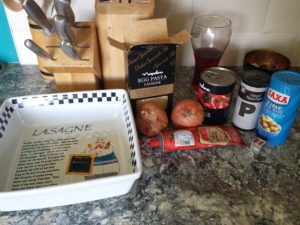 Here are some of the things I used to make a recent lasagne. It’s fairly hard to see, but there’s a bowl of home grown garlic at the back, on the right. Just push garlic cloves that are too small to bother peeling into the ground. A few months later, they will have multiplied enormously, and somehow pulled themselves down until they are six inches underground. I have no idea how they manage to do that, but they do. I must remember to ask my favourite botanist, if he ever visits us.
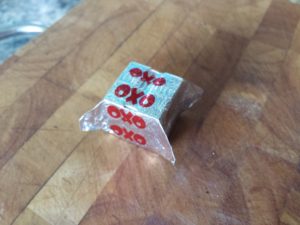 This is the humble, yet powerful, Oxo cube that I used, to flavour the rather insipid looking beef mince. Some people tear the foil off, and crumble the cube with their fingers. Try this… Pull the little flaps out as shown, and hit the cube a couple of times
 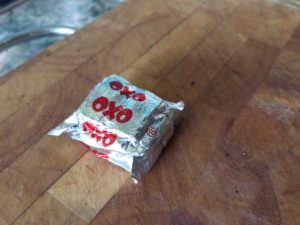 with your palm, until it is flattened. Now you can just rip it and tip the powdered Oxo straight into the pan. Isn’t that clever? I would credit the source of the tip, if I could remember it.
 That meat will need to be browned properly, of course, before you carry on making the sauce, but you know that, don’t you? I wasn’t following a recipe, just doing what seemed likely to be the way I have made lasagne before.
 Now some recipes have you put layers of sauce in with the layers of meat and pasta. I don’t do that, mainly because it increases hugely the amount of sauce you will need, and tends to make the final dish sloppy. I have been known to put in layers of grated cheese, and that can work quite well, but this lasagne didn’t have any.
 ends up knowing how to do without measuring things. A lump of butter of a certain size. A big, but not too big, spoonful of flour. Do not forget Colman’s mustard powder, about half a teaspoonful. It’s not enough to make the sauce taste mustardy, but it will seem dull if you forget to put it in.
  The butter and flour have to be cooked until there is what one recipe book describes as a “biscuity smell”.
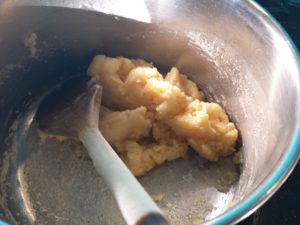 cheese. Please use a decent Cheddar, not soapy cheap stuff.
 picture, along with a salad that miraculously appeared while the lasagne was cooking.