
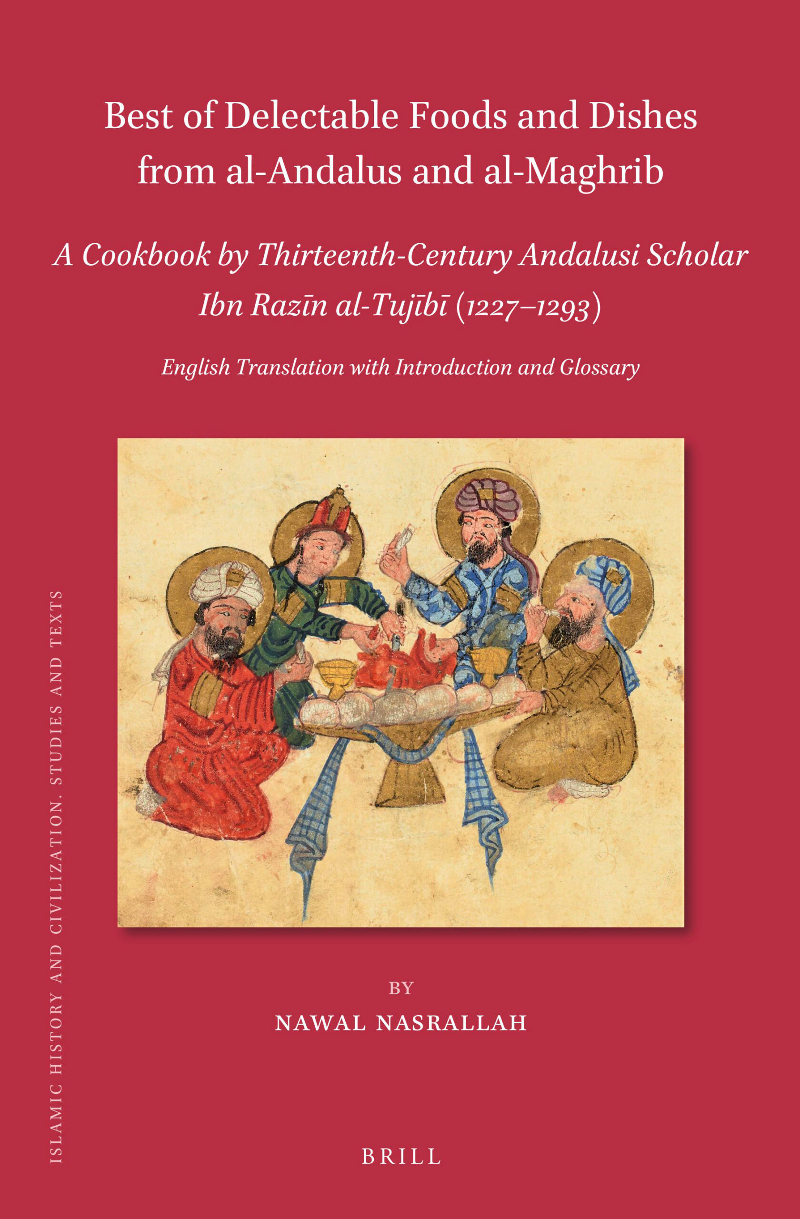
I have been reading this cookery book, because who doesn’t read cookery books? It’s a translation of a 13th Century book, written by a Moorish scholar who loved the food in Andalusia and Maghrib. ISBN 978-9004469471. It can be bought from Blackwells, if you have a awful lot of money to spare. Even the paperback is £42! Fortunately, it is possible to obtain it as a .pdf file.
I have so far read the very informative, scholarly introduction by the translator, the section on bread, and am now well into the meat dishes section.
I wasn’t particularly surprised to find that none of the recipes include weights or volumes of ingredients. That sort of thing is common in old recipe books. By old, I mean Mrs Beeton era, not the tatty Good Housekeeping book one tends to inherit when the oldies move on to somewhere food doesn’t matter any more… Those are quite good.
But I was a little surprised to find how many of the meat stews were served by breaking a lot of bread into tiny bits in a bowl, pouring stew juices on the bread, and layering meat on top, often followed by an egg mix. I couldn’t think of anywhere I had seen this, until I went to our cookbook library and searched a few favourite books.
There was nothing like this in Arto der Haroutounian’s Penguin paperback, “Complete Arab Cookery”, as far as I could see. But then I thought, who has written more knowledgeably about Middle Eastern food than anyone else I can think of? Claudia Roden, obviously. She’s a cookery book superhero, and in “Arabesque” (ISBN 978-0-718-14581-1) there are two recipes that are served that way. One is Turkish, “Kofte Kebab with Tomato Sauce and Yoghourt” on page 212, and the other is Lebanese, “Chicken and Chickpeas with Yoghourt”, on page 307.

I did also look briefly in Clarissa Dickson Wright’s “A History of English Food”, (ISBN 978-0-099-51494-7) to see if there was anything similar in our own food history. At first, I couldn’t find anything, but then I remembered – we didn’t bother with the bowl. The bread was a flat loaf called a trencher, left intact instead of breaking it up, and the meat and gravy went on top of that. And anyone who ate all of the meat, and the gravy-soaked trencher as well, as called a “trencherman”.
Now, back to my reading…
