
My Mum and Dad liked children. At least, I suppose they did, because they had five of us. They did a good job of teaching us many important things, including compassion, thinking carefully about things, and cookery. Once, when I expressed pleasure that some unusually revolting public figure had died, Mum told me off. “He was some woman’s son”, she said.
The building site next door has been quiet today. They have been given the day off, because today is the fiftieth anniversary of the Aberfan Disaster. I was 17 when it happened, and I wept for hours. Thinking about it today, it is still hard to hold back the tears.
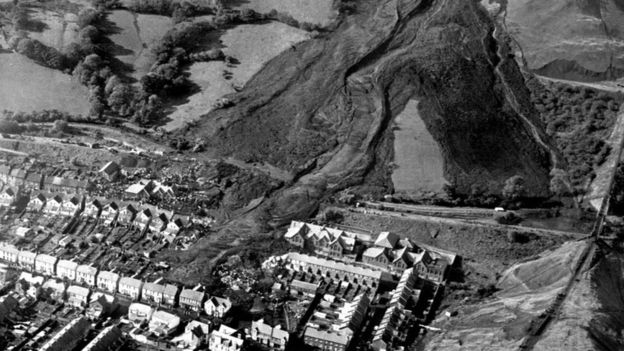
The slip of waste coal killed 144 people, including 116 children, who were in the school next to the tip. A hundred and sixteen children. A fund was set up to help, not that there is any way money can compensate for the loss of even a single child, let alone a hundred and sixteen.
Today, fifty years on, as people here quietly remember this disaster, we have millionaires who own tabloid newspapers, and pay truly horrible journalists to write pieces in which they mock the drowning of children fleeing from wars, and claim they were “staged”. When we help refugees, they write demanding the children be X-rayed to prove they are children.
It is not easy to cope with the vicious, right-wing, unpleasantness that is now so common in the UK. It is very depressing to see what so many of us have descended to, after being the heroic nation that helped to save Europe from fascism. But I shall not give up. I shall continue to urge politicians, above all, but everyone else as well, to be decent.
Comments are off because, sadly, I am only too familiar with the sort of response that thugs make to articles of this kind.









 We had a roast-in-the-bag duck crown in the freezer, but I wanted to feed the three of us, so I bought a couple of extra duck breasts. These Gressingham duck items seem to be in most UK supermarkets, and they are rather good. I also didn’t want to have all the faff of cutting the duck off the bones after it was
 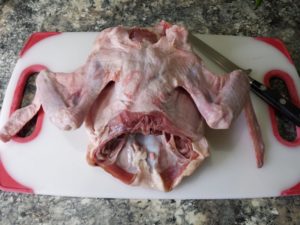 cooked, so I decided to remove all the bones before starting, and combine all the meat into a single roast. On the left, you can see what is inside the roasting bag. The legs, and the tail end have gone to other customers. I often use the leg joints for confit duck.
 Anyway, I sharpened my boning knife, and set to… here I have cut away the wings, and started to separate the breast from the rib cage, taking care not to cut the skin.
 By this point, the rib cage, spine, and shoulder bones have gone into the stock pot, along with the wings, and are being boiled up for a lovely stock. The whole thing is a bit untidy, as this was the first attempt at this task, so I cut off the untidy edges, and rendered the fat from them, to add to my collection of duck fat.
  When I have enough, I will be able to do confit duck legs again.
 The picture shows the second try, because the first time I did it, the two separate duck breasts slid out as I tightened the knots. It probably wasn’t as funny as I thought…
 Here it is, in the handy aluminium tray that was supplied with the duck crown. I inserted a thermometer probe into the duck, as I didn’t want to ruin it by overcooking it. Anything over 50ºC would do that, according to the online sources I looked at. That’s 122ºF, if you are cooking in old money, as I believe some
 countries do. I roasted it at 180ºC until the thermometer started beeping, and took it out of the oven to rest while I cooked the vegetables. The heat in the outer parts of the duck were conducted to the centre, and I was quite worried as it achieved a core temperature of 55ºC during that time, with no additional heat.
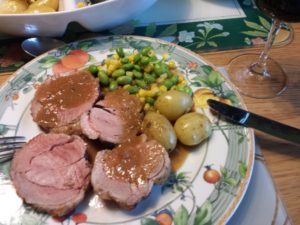 time I try this. Overall, though, I was very pleased with this meal. The sauce was a chicken gravy from the store cupboard (Bisto, since you ask) flavoured with some hoi-sin sauce. New potatoes, sweetcorn, and soya beans were good, too.
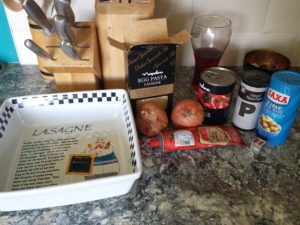 Here are some of the things I used to make a recent lasagne. It’s fairly hard to see, but there’s a bowl of home grown garlic at the back, on the right. Just push garlic cloves that are too small to bother peeling into the ground. A few months later, they will have multiplied enormously, and somehow pulled themselves down until they are six inches underground. I have no idea how they manage to do that, but they do. I must remember to ask my favourite botanist, if he ever visits us.
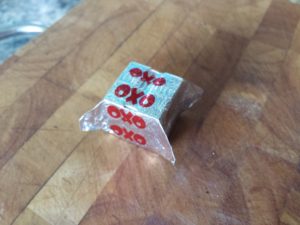 This is the humble, yet powerful, Oxo cube that I used, to flavour the rather insipid looking beef mince. Some people tear the foil off, and crumble the cube with their fingers. Try this… Pull the little flaps out as shown, and hit the cube a couple of times
 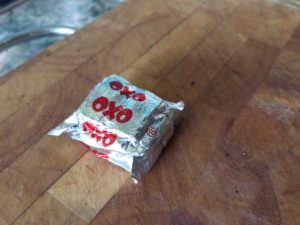 with your palm, until it is flattened. Now you can just rip it and tip the powdered Oxo straight into the pan. Isn’t that clever? I would credit the source of the tip, if I could remember it.
 That meat will need to be browned properly, of course, before you carry on making the sauce, but you know that, don’t you? I wasn’t following a recipe, just doing what seemed likely to be the way I have made lasagne before.
 Now some recipes have you put layers of sauce in with the layers of meat and pasta. I don’t do that, mainly because it increases hugely the amount of sauce you will need, and tends to make the final dish sloppy. I have been known to put in layers of grated cheese, and that can work quite well, but this lasagne didn’t have any.
 ends up knowing how to do without measuring things. A lump of butter of a certain size. A big, but not too big, spoonful of flour. Do not forget Colman’s mustard powder, about half a teaspoonful. It’s not enough to make the sauce taste mustardy, but it will seem dull if you forget to put it in.
  The butter and flour have to be cooked until there is what one recipe book describes as a “biscuity smell”.
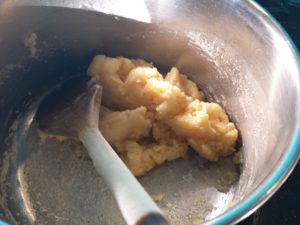 cheese. Please use a decent Cheddar, not soapy cheap stuff.
 picture, along with a salad that miraculously appeared while the lasagne was cooking.
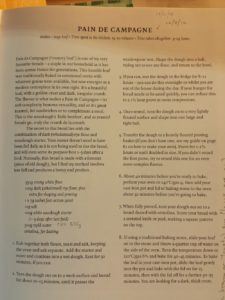

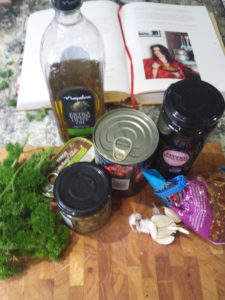 This was a dish I had been wanting to make for a while, although I was told I had done it before. Well, I’m allowed to forget things sometimes. As you can see, I’m using a Nigella recipe. It’s all over the internet, along with the scene from “A Series of Unfortunate Events” in which the children serve it. The recipe is everywhere, too, and is very simple.
